
You feel tired for weeks. Maybe you have a mild ache that comes and goes. Your temperature is slightly elevated but not enough to call it a fever. Something feels off — but nothing shows up on a basic test. This is exactly the scenario where an ESR blood test becomes your doctor's most valuable diagnostic tool. If you are searching for an ESR test at a pathology lab in Ahmedabad, this guide explains everything you need to know.
What Is an ESR Test?
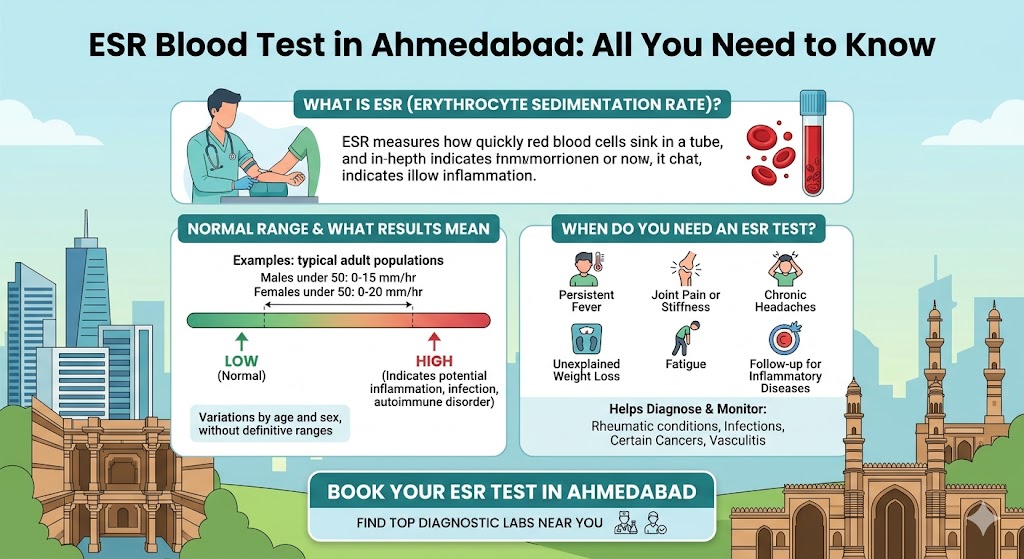
ESR stands for Erythrocyte Sedimentation Rate. It is one of the oldest and most widely used blood tests in medicine — and for good reason. The test measures how quickly your red blood cells (erythrocytes) settle to the bottom of a test tube filled with blood over one hour. When there is inflammation anywhere in the body, certain proteins cause red blood cells to clump together and fall faster — resulting in a higher ESR reading.
ESR is not a disease-specific test. It does not tell your doctor exactly what is wrong. But it is an extremely sensitive early warning signal — a red flag that tells your doctor something is going on inside that warrants further investigation.
ESR Normal Range — What the Numbers Mean
What Does a High ESR Indicate?
A high ESR is not a diagnosis — it is a signal. It tells your doctor that inflammation, infection or tissue damage is present somewhere in the body. Here are the most common conditions associated with an elevated ESR:
Infections
Bacterial infections — tuberculosis (TB), bacterial endocarditis, osteomyelitis
Viral infections — including post-viral inflammation (read our fever profile test guide for more on infection testing)
Fungal infections in immunocompromised individuals
Autoimmune & Inflammatory Conditions
Rheumatoid Arthritis — one of the most common causes of persistently high ESR
Lupus (Systemic Lupus Erythematosus)
Polymyalgia Rheumatica — especially in adults over 50
Inflammatory Bowel Disease (Crohn's Disease, Ulcerative Colitis)
Other Causes
Anaemia — low red blood cells cause faster sedimentation
Kidney disease — protein loss through urine elevates ESR
Thyroid disorders — an overactive or underactive thyroid can raise ESR levels
Certain cancers, especially lymphoma and multiple myeloma
ESR vs CRP — What Is the Difference?
Both ESR and CRP (C-Reactive Protein) are inflammation markers, but they behave differently. CRP rises and falls rapidly — within hours of an inflammatory event. ESR rises and falls more slowly — over days to weeks. This makes CRP better for detecting acute (sudden) inflammation, while ESR is better for monitoring chronic (long-term) conditions. Your doctor will often order both together alongside a complete blood count (CBC) for a comprehensive inflammation picture.
When Should You Get an ESR Test in Ahmedabad?
Persistent unexplained fatigue lasting more than 2–3 weeks
Low-grade fever that does not resolve with basic treatment
Unexplained joint pain, stiffness or swelling — especially in the morning
Suspected autoimmune condition or family history of rheumatoid arthritis
Monitoring a known chronic condition such as TB, lupus or inflammatory bowel disease
As part of an annual health checkup after 40 — particularly for women who are more susceptible to autoimmune disorders
No fasting is required for an ESR test. You can walk into any pathology lab near you at any time, or book our free home sample collection for the same accurate results at home.
Get Your ESR Test Done at a Trusted Blood Test Lab in Ahmedabad
At Shanti Pathology Laboratory, ESR tests are run alongside CBC and CRP as a complete inflammation panel, verified by experienced pathologists and reported the same day. Our diagnostic services cover the full spectrum of blood tests used in Ahmedabad — from basic screenings to complex disease monitoring.
Visit us at Naranpura, Paldi, Maninagar or Gandhinagar, or book a home visit online. Check our health packages that bundle ESR with CBC, CRP and other key tests at the best value.