You just received your thyroid test report and you are staring at numbers like TSH: 6.2 mIU/L or Free T4: 0.7 ng/dL — and you have no idea what any of it means. You are not alone. Thyroid reports confuse millions of patients every year, even those who have been dealing with thyroid issues for years.
In this guide, we break down every component of a thyroid test report in plain, simple language — so you can understand your results, have a more informed conversation with your doctor, and take charge of your health.
What Is the Thyroid and Why Does It Matter?
The thyroid is a small, butterfly-shaped gland located at the front of your neck. Despite its small size, it controls some of the most important functions in your body — including your metabolism, energy levels, heart rate, body temperature, mood, and even hair and skin health.
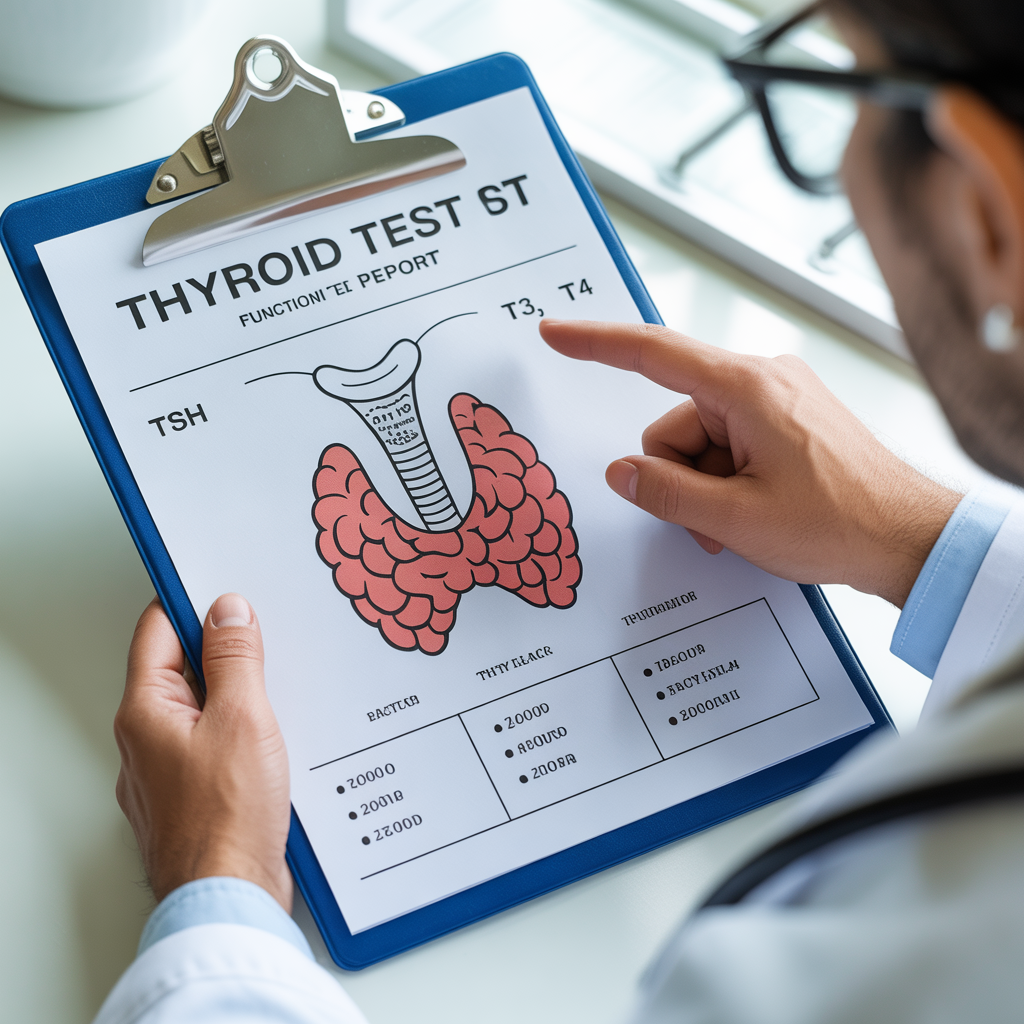
When the thyroid produces too little hormone (hypothyroidism) or too much (hyperthyroidism), it throws your entire body out of balance. The thyroid function test (TFT) measures three key markers — TSH, T3, and T4 — to determine how well your thyroid is working.
TSH — Thyroid Stimulating Hormone
TSH is produced by the pituitary gland in your brain and acts as a messenger that tells the thyroid how much hormone to produce. Think of TSH as the volume knob on your thyroid.
Normal range: 0.4 to 4.0 mIU/L (may vary slightly by lab)
High TSH: Means your brain is signalling the thyroid to work harder — usually a sign of hypothyroidism (underactive thyroid)
Low TSH: Means your thyroid is already overproducing — usually a sign of hyperthyroidism (overactive thyroid)
TSH is usually the first test ordered when a thyroid problem is suspected. It is the most sensitive marker and is included in almost every thyroid profile.
T3 — Triiodothyronine
T3 is one of the two main hormones produced by the thyroid. It is the more active form and plays a direct role in regulating metabolism, heart rate, and body temperature.
Total T3 normal range: 80 to 200 ng/dL
Free T3 normal range: 2.3 to 4.2 pg/mL
Low T3: Associated with hypothyroidism, malnutrition, or severe illness
High T3: Can indicate hyperthyroidism or T3 toxicosis
Free T3 (FT3) is a more accurate measurement than Total T3 because it measures the hormone that is actually available for your body to use.
T4 — Thyroxine
T4 is the main hormone produced by the thyroid in large quantities. Most T4 is converted into the more active T3 in the liver and other tissues. T4 itself has a slower, longer-lasting effect compared to T3.
Total T4 normal range: 5.0 to 12.0 mcg/dL
Free T4 normal range: 0.8 to 1.8 ng/dL
Low T4: Suggests the thyroid is not producing enough hormone — hypothyroidism
High T4: May indicate hyperthyroidism or excess thyroid hormone intake
Free T4 (FT4) is preferred over Total T4 in most modern thyroid panels because it is not affected by protein levels in the blood.
How to Read Your Thyroid Report — Common Patterns
High TSH + Low T3/T4: Classic hypothyroidism. Your thyroid is underactive and not producing enough hormone.
Low TSH + High T3/T4: Classic hyperthyroidism. Your thyroid is overactive and producing too much hormone.
High TSH + Normal T3/T4: Subclinical hypothyroidism. Early stage — monitor closely and follow doctor's advice.
Normal TSH + Normal T3/T4: Your thyroid is functioning normally.
Symptoms That Mean You Should Get a Thyroid Test
You should speak to your doctor about getting a thyroid test if you experience any of the following:
Unexplained weight gain or weight loss
Persistent fatigue and low energy despite adequate sleep
Hair thinning or excessive hair fall
Feeling unusually cold or unusually warm all the time
Depression, anxiety, or mood swings without clear reason
Irregular or missed menstrual cycles in women
Constipation or frequent loose stools
Swelling in the neck (goitre)
Get Your Thyroid Test Done at a Pathology Lab Near You
A thyroid profile test is quick, affordable, and requires only a small blood sample. The best time to get it done is in the morning after fasting. If you are looking for a pathology lab near you in Ahmedabad or Gandhinagar, Shanti Pathology Laboratory offers accurate thyroid testing at all four of our branches:
Naranpura Branch — 132 Feet Ring Rd, near AEC Cross Road, Ahmedabad 380013
Paldi Branch — Sukhshanti Complex, Paldi, Ahmedabad 380007
Maninagar Branch — Rajratan Complex, Maninagar, Ahmedabad 380008
Gandhinagar Branch — Surbhi Complex, Sector 6, Gandhinagar 382006
We also offer free home sample collection, so you do not even need to leave your house. Simply call us to book.
Conclusion
Understanding your thyroid test report is not complicated once you know what TSH, T3, and T4 mean. If your results fall outside the normal range, do not panic — thyroid conditions are highly manageable with the right treatment. Always discuss your report with a qualified doctor before making any decisions. And if you are due for a thyroid test, visit Shanti Pathology Laboratory or call us at +91 98795 08835. You can also book online at shantipathologylab.com.