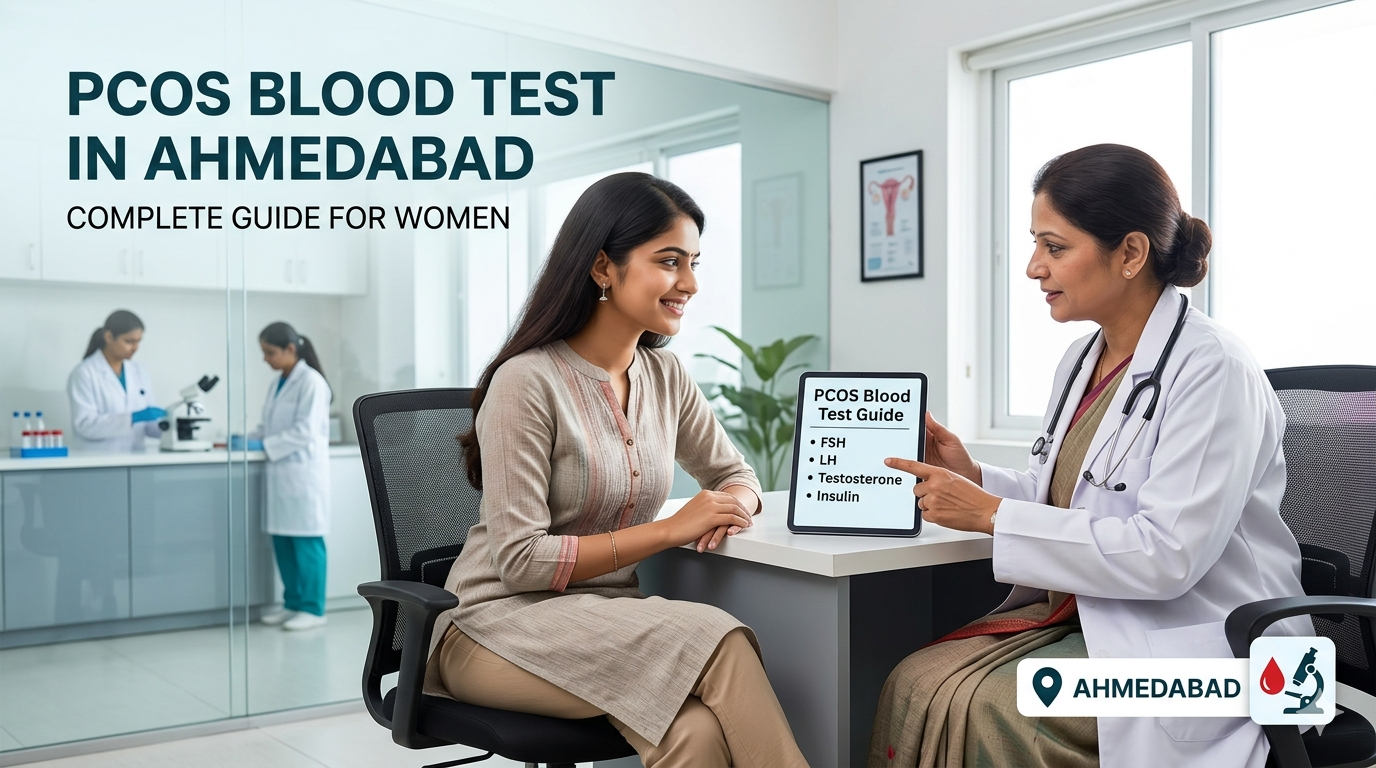
1 in every 5 women in India is estimated to have Polycystic Ovary Syndrome (PCOS) — yet the majority remain undiagnosed for years. They are told their irregular periods are "normal", their weight gain is a lifestyle issue, or their hair loss is stress-related. But these are not random problems — they are symptoms of a hormonal condition that requires proper diagnosis and management.
If you are a woman in Ahmedabad experiencing unexplained weight gain, irregular periods, acne, excessive hair growth, or difficulty conceiving — this guide is for you. Here is everything you need to know about PCOS blood tests: which tests to get, when to get them, what the results mean, and where to find the most trusted blood test lab in Ahmedabad for hormonal testing.
What Is PCOS?
Polycystic Ovary Syndrome (PCOS) is a common hormonal disorder affecting women of reproductive age. It is characterised by a combination of:
Irregular or absent menstrual periods
Elevated levels of androgens (male hormones) — causing acne, excess facial/body hair, and hair thinning
Polycystic ovaries — ovaries containing multiple small, immature follicles visible on ultrasound
PCOS is not just a reproductive condition. It is a metabolic and endocrine disorder that affects your insulin sensitivity, cardiovascular health, mental health, and long-term risk of Type 2 Diabetes. Early diagnosis through a comprehensive PCOS blood test is the first and most important step toward managing it effectively.
PCOS Symptoms — Do You Recognise These Signs?
PCOS presents differently in different women. Some women have all the classic symptoms; others have only a few. Here are the most common signs to watch for:
Menstrual Irregularities
Periods that come every 35 to 90 days — or not at all
Very light or very heavy bleeding
Spotting between periods
Fewer than 8 periods in a year
Signs of Elevated Androgens (Male Hormones)
Acne on the face, chest, or back that does not respond to regular treatment
Excessive hair growth on the face, chin, chest, or abdomen (hirsutism)
Thinning hair or male-pattern hair loss (androgenic alopecia)
Oily skin
Metabolic Symptoms
Unexplained weight gain — especially around the abdomen
Intense sugar cravings and difficulty losing weight
Extreme fatigue after meals
Dark, velvety skin patches on the neck, armpits, or groin (acanthosis nigricans) — a sign of insulin resistance
Fertility and Emotional Impact
Difficulty getting pregnant due to irregular or absent ovulation
Mood swings, anxiety, or depression
Low self-esteem related to physical symptoms
💡 Important: You do not need to have all these symptoms to have PCOS. Even two or three of these signs — especially irregular periods combined with any androgen symptom — should prompt a blood test and medical consultation.
Which Blood Tests Are Done for PCOS Diagnosis in Ahmedabad?
A proper PCOS diagnosis requires a panel of hormone and metabolic blood tests — not just one or two. Here is the complete PCOS blood test panel recommended by gynaecologists and endocrinologists:
⚠️ Note: These tests must ideally be done on Day 2 or Day 3 of your menstrual cycle for the most accurate hormonal readings — especially LH, FSH, testosterone, and AMH. Always follow your doctor's timing instructions.
The 4 Types of PCOS — Why Your Blood Test Results Matter
PCOS is not a one-size-fits-all condition. There are four distinct types, each with a different root cause and treatment approach. Your blood test results help identify which type you have:
Understanding your PCOS type through blood tests is critical — because the wrong treatment for the wrong type can make symptoms worse, not better. This is why a comprehensive hormonal panel from a reliable pathology lab in Ahmedabad is the foundation of effective PCOS management.
How to Prepare for a PCOS Blood Test
Proper preparation ensures accurate results. Follow these guidelines before your PCOS blood test in Ahmedabad:
Timing Is Critical
Most hormonal tests (LH, FSH, Testosterone, AMH) should be done on Day 2 or Day 3 of your menstrual cycle
If your periods are very irregular or absent, your doctor will advise the best time for testing
Prolactin should ideally be tested in the morning — preferably within 2 hours of waking up
Fasting Requirements
Fasting for 8 to 12 hours is required for fasting insulin, fasting blood sugar, HbA1c, and lipid profile
Water is allowed during the fasting period
Do not exercise intensely before the test — it can temporarily alter hormone levels
Medications to Discuss With Your Doctor
If you are currently on oral contraceptive pills (OCP) — inform your doctor, as they suppress LH, FSH, and testosterone levels and can mask PCOS
Stop OCPs for at least 3 months before hormonal testing, if your doctor advises
Inform the lab about any supplements — especially biotin, which can interfere with certain hormone assays
How to Read Your PCOS Blood Test Results
LH:FSH Ratio — The Classic PCOS Marker
In a normal menstrual cycle, LH and FSH are roughly equal (1:1 ratio). In PCOS, LH is typically elevated while FSH remains normal or low, leading to a ratio greater than 2:1 — and sometimes as high as 3:1 or more. This elevated ratio is one of the most consistent findings in PCOS and indicates that ovulation is not occurring normally.
High Testosterone — The Androgen Marker
Elevated testosterone — either total or free — confirms hyperandrogenism, which is responsible for the most visible PCOS symptoms: acne, hirsutism (facial/body hair), and hair thinning. Not every PCOS patient has high testosterone, but when present, it strongly supports the diagnosis.
High AMH — The Ovarian Reserve Marker
AMH (Anti-Müllerian Hormone) is produced by follicles in the ovary. In PCOS, a large number of small, immature follicles produce excessive AMH — leading to levels significantly above normal. A very high AMH (above 3.5–4.0 ng/mL) is a strong indicator of polycystic ovaries, even without an ultrasound.
High Fasting Insulin — The Metabolic Marker
Insulin resistance is present in approximately 70% of PCOS patients — including those who are not overweight. A fasting insulin level above 25 µIU/mL, combined with a normal or elevated blood sugar, indicates insulin resistance. This is the key driver of weight gain, sugar cravings, and long-term diabetes risk in PCOS.
TSH — Ruling Out Thyroid Disease
Thyroid dysfunction — both hypothyroidism and hyperthyroidism — can cause irregular periods and mimic PCOS symptoms. Testing TSH alongside PCOS markers is essential to rule out a thyroid condition that may be the real or contributing cause.
Read more: Understanding Your Thyroid Test Report: TSH, T3, T4 Explained Simply
PCOS and Long-Term Health Risks — Why Early Testing Matters
PCOS is far more than a period problem. Left undiagnosed and unmanaged, it significantly increases the risk of serious long-term health conditions:
Type 2 Diabetes — women with PCOS are 4 to 7 times more likely to develop diabetes
Cardiovascular disease — due to insulin resistance, high cholesterol, and chronic inflammation
Endometrial cancer — caused by prolonged periods without ovulation (unopposed estrogen)
Obstructive sleep apnea — especially in overweight women with PCOS
Non-alcoholic fatty liver disease (NAFLD) — linked to insulin resistance
Depression and anxiety — affecting up to 60% of women with PCOS
This is why a PCOS blood test is not just about diagnosing a hormonal imbalance — it is about protecting your health for the next 30 to 40 years.
Why Is PCOS So Common Among Women in Ahmedabad?
Several lifestyle and environmental factors specific to urban India — and Ahmedabad in particular — are contributing to the rising prevalence of PCOS:
High-carbohydrate, high-sugar diet — white rice, maida, sweets, and processed foods spike insulin levels
Sedentary lifestyle — desk jobs, long commutes, and reduced physical activity
High stress levels — chronic stress elevates cortisol, which disrupts hormonal balance
Disrupted sleep patterns — late nights and irregular sleep cycles worsen insulin resistance
Environmental endocrine disruptors — plastics, pesticides, and pollutants that mimic hormones
Delayed marriage and pregnancy — changes in reproductive patterns affect hormonal health
Shanti Pathology Laboratory — Trusted Blood Test Lab in Ahmedabad for PCOS Testing
Getting the right tests done at the right lab is critical for PCOS diagnosis. Hormonal testing requires high-precision equipment and proper sample handling — because even small errors can lead to significantly different results.
Shanti Pathology Laboratory is one of the best pathology labs in Ahmedabad for women's hormonal health testing. Thousands of women across Ahmedabad trust us for accurate, affordable, and confidential PCOS blood testing.
Why Women in Ahmedabad Choose Shanti Pathology Laboratory
✅ Comprehensive PCOS Panel — All 13 tests available under one roof
✅ Hormone-Specific Analyzers — High-precision equipment for accurate hormonal results
✅ Experienced Pathologists — Reports interpreted by qualified specialists
✅ Home Sample Collection — Book a slot and get tested from home — no need to travel while unwell
✅ Confidential & Sensitive Service — Your privacy is our priority
✅ Same-Day Reports — Results available within hours for most PCOS panel tests
✅ Affordable Pricing — Transparent rates with no hidden charges
✅ 4 Convenient Locations — Across Ahmedabad and Gandhinagar
Shanti Pathology Laboratory Centres — Ahmedabad
📍 Naranpura — Torrent Power, Swaminarayan Avenue, B/113, 132 Feet Ring Rd, near AEC Cross Road
📍 Paldi — Sukhshanti Complex, Paldi
📍 Maninagar — Rajratan Complex, Maninagar
📍 Gandhinagar — Surbhi Complex, Sector 6
📞 98795 08835 🌐 shantipathologylab.com
Searching for a pathology lab near me in Ahmedabad for PCOS testing? With home sample collection available across the city, you can get tested without stepping out — especially important if you are managing fatigue, pain, or heavy bleeding.
Managing PCOS — What You Can Do After Your Diagnosis
A positive PCOS diagnosis is not the end — it is the beginning of taking back control of your health. Here are evidence-based steps that make a significant difference:
1. Diet Changes
Switch to a low glycaemic index (low GI) diet — whole grains, vegetables, legumes, and lean protein
Reduce sugar, maida, white rice, and processed foods
Eat smaller, more frequent meals to manage insulin spikes
Include anti-inflammatory foods — turmeric, omega-3-rich fish, nuts, and seeds
2. Exercise Regularly
Aim for at least 30 minutes of moderate exercise 5 days a week
Strength training is especially effective for improving insulin sensitivity in PCOS
Yoga and mindful movement can help manage stress hormones that worsen PCOS
3. Manage Stress
Chronic stress elevates cortisol, which disrupts LH and FSH balance and worsens insulin resistance
Practice meditation, deep breathing, or progressive muscle relaxation daily
4. Regular Monitoring
Get your PCOS hormone panel retested every 6 months to track your progress. Also monitor your HbA1c and fasting blood sugar regularly to watch for pre-diabetes — especially if insulin resistance is present.
Frequently Asked Questions (FAQs)
Q: Which blood tests confirm PCOS?
A: PCOS is diagnosed using a combination of LH, FSH, LH:FSH ratio, testosterone (total and free), DHEA-S, AMH, prolactin, TSH, fasting insulin, fasting blood sugar, and HbA1c. Ultrasound is often done alongside blood tests for a complete diagnosis.
Q: On which day of my cycle should I get a PCOS blood test?
A: Most hormonal tests — especially LH, FSH, and testosterone — should be done on Day 2 or Day 3 of your menstrual cycle. AMH can be tested on any day. If your periods are very irregular, consult your gynaecologist for the right testing window.
Q: Can I have PCOS even if my ultrasound is normal?
A: Yes. PCOS is diagnosed based on the Rotterdam Criteria — which requires at least 2 of the following 3 features: irregular periods, elevated androgens (by blood test or symptoms), and polycystic ovaries on ultrasound. A normal ultrasound does not rule out PCOS if blood test results and symptoms are positive.
Q: Can PCOS be cured?
A: PCOS currently has no permanent cure, but it is highly manageable with the right lifestyle changes, medication, and monitoring. Many women with PCOS achieve regular periods, healthy weight, clearer skin, and successful pregnancies with proper management.
Q: Can I get a PCOS blood test done at home in Ahmedabad?
A: Yes! Shanti Pathology Laboratory offers convenient home blood sample collection across Ahmedabad — so you can get your complete PCOS panel done without visiting the lab.
Q: Is a PCOS blood test expensive in Ahmedabad?
A: At Shanti Pathology Laboratory, PCOS testing is available at affordable and transparent prices. Individual tests can be done separately, or you can ask about bundled women's health packages that include multiple PCOS markers at a discounted rate.
Q: My periods are irregular — could it be thyroid and not PCOS?
A: Absolutely — thyroid dysfunction and PCOS have overlapping symptoms. That is why TSH is always included in the PCOS panel. Read our guide on Understanding Your Thyroid Test Report to understand the difference.
Conclusion
PCOS affects millions of women silently — disrupting periods, hormones, metabolism, fertility, and mental health. But it does not have to control your life. With the right diagnosis — starting with a comprehensive PCOS blood test — you can understand exactly what is happening in your body and take targeted steps to manage it.
If you are in Ahmedabad and looking for accurate, affordable, and confidential PCOS hormonal testing, Shanti Pathology Laboratory is your most trusted partner. As one of the best pathology labs in Ahmedabad, we offer a complete PCOS panel, home sample collection, and same-day reports — all backed by experienced pathologists who understand women's health.
📞 98795 08835 | shantipathologylab.com | Book Your PCOS Test Today