
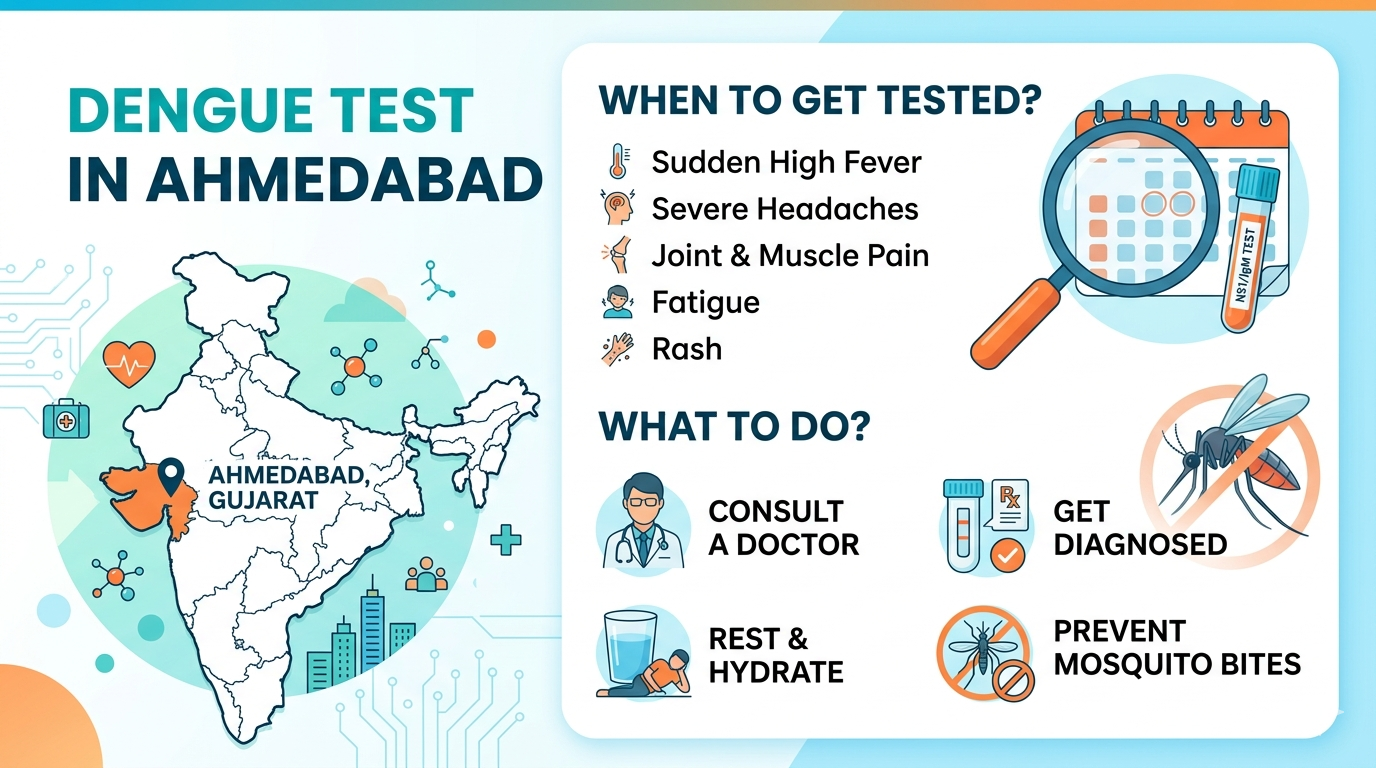
Every monsoon season, Ahmedabad faces a sharp rise in dengue fever cases. Stagnant water in streets, construction sites, and even household flower pots become breeding grounds for the Aedes mosquito — the primary carrier of the dengue virus. And once infected, the difference between a mild illness and a life-threatening condition often comes down to one thing: how early you get tested.
If you or someone in your family has a sudden high fever, severe body pain, or a dramatic drop in energy — do not wait. This complete guide tells you exactly which dengue test to get in Ahmedabad, when to get it, how to read your results, and what steps to take immediately after diagnosis.
What Is Dengue Fever? A Quick Overview
Dengue is a mosquito-borne viral infection caused by the dengue virus (DENV), transmitted by the bite of an infected female Aedes aegypti mosquito. Unlike the common mosquito, the Aedes mosquito bites primarily during the day — making it harder to avoid.
Dengue is NOT contagious — it does not spread from person to person. However, in severe cases, it can progress to Dengue Hemorrhagic Fever (DHF) or Dengue Shock Syndrome (DSS), both of which are potentially fatal without immediate medical care.
Dengue Symptoms — When Should You Be Concerned?
Dengue symptoms typically appear 4 to 10 days after a mosquito bite. Watch out for:
Classic Dengue Symptoms
Sudden high fever — 102°F to 104°F — appearing without warning
Severe headache, especially behind the eyes (retro-orbital pain)
Intense muscle and joint pain — dengue is often called 'breakbone fever'
Skin rash — a red, measles-like rash appearing on day 3 to 5
Nausea, vomiting, and loss of appetite
Extreme fatigue and weakness
Warning Signs of Severe Dengue — Seek Emergency Care Immediately
🚨 These are RED FLAG symptoms. If you notice any of these, go to a hospital immediately — do not wait for test results.
Severe abdominal pain or persistent vomiting
Bleeding from the nose, gums, or in urine/stool
Blood in vomit
Rapid breathing or difficulty breathing
Sudden drop in blood pressure or cold, clammy skin
Platelet count dropping below 50,000 / µL
Extreme restlessness or confusion
Which Dengue Test Should You Get in Ahmedabad?
This is the most critical question — and the answer depends entirely on how many days ago your fever started. Getting the wrong test at the wrong time can give a false negative result, leading to dangerous delays in treatment.
💡 Pro Tip: The Dengue Combo Test (NS1 + IgM + IgG) is the most comprehensive option and is recommended by most doctors in Ahmedabad for accurate diagnosis at any stage of the illness.
When Exactly Should You Get a Dengue Test in Ahmedabad?
Day 1 to Day 5 of Fever — Get NS1 Antigen Test
The NS1 (Non-Structural Protein 1) antigen test is the most reliable test in the first 5 days of dengue infection. The dengue virus produces the NS1 protein in large quantities during the early stage of infection, making it detectable in the blood before antibodies have formed. If you have had fever for less than 5 days, this is the test to get.
Day 5 Onwards — Add IgM Antibody Test
From around day 5, your immune system begins producing IgM antibodies in response to the dengue virus. The IgM test detects these antibodies and is the standard confirmation test for dengue after the first five days. A positive IgM result strongly confirms a current or very recent dengue infection.
Day 7 and Beyond — IgG Antibody Test
The IgG test detects long-term antibodies that develop after day 7. A positive IgG result can indicate either a past infection or, in some cases, a secondary dengue infection — which is often more severe than the first.
Throughout the Illness — CBC for Platelet Monitoring
Regardless of which dengue-specific test you take, a Complete Blood Count (CBC) is essential throughout your illness. The CBC tracks your platelet count and white blood cell levels — both of which drop significantly during dengue and are the primary indicators of how severe your condition is.
Read more: Complete Blood Count (CBC) Test — What It Reveals About Your Health
Understanding Your Dengue Test Results
NS1 Antigen Result
Positive NS1 → Dengue infection confirmed. Start medical treatment immediately.
Negative NS1 (but fever persists) → Test again after day 5 with IgM antibody test.
IgM / IgG Antibody Result
IgM Positive + IgG Negative → Primary (first-time) dengue infection
IgM Positive + IgG Positive → Secondary dengue infection — higher risk of complications
IgM Negative + IgG Positive → Past infection, currently recovered
Both Negative (early fever) → Test too early; repeat NS1 or IgM after day 5
Understanding Your Platelet Count in Dengue
This is the number your doctor will watch most closely during dengue illness:
⚠️ Important: Platelet count can drop rapidly in dengue — sometimes by 20,000 to 30,000 in a single day. Daily CBC monitoring is critical once dengue is confirmed.
What to Do After a Positive Dengue Test — Step-by-Step
Step 1 — Contact Your Doctor Immediately
Do not attempt to self-treat dengue. Contact your physician immediately after a positive result. They will assess your severity and advise whether home management or hospitalisation is required.
Step 2 — Monitor Platelet Count Daily
Once dengue is confirmed, get a CBC done every day. Tracking the rate of platelet decline is more important than the single count reading. A rapid daily drop is a red flag even if the count is not yet critically low.
Step 3 — Hydrate Aggressively
Dengue causes significant fluid loss. Drink at least 3 to 4 litres of water, oral rehydration solution (ORS), coconut water, and clear soups per day. Adequate hydration can prevent dengue shock syndrome.
Step 4 — Take Paracetamol Only — Never Ibuprofen or Aspirin
🚨 Critical Warning: Never take ibuprofen (Brufen), aspirin, or diclofenac for dengue fever. These drugs thin the blood and can trigger life-threatening internal bleeding in dengue patients. Use only paracetamol for fever management.
Step 5 — Rest Completely
Complete bed rest is essential. Avoid any physical exertion. The body needs all its energy to fight the dengue virus.
Step 6 — Prevent Mosquito Bites
While recovering, use mosquito nets and repellents. An infected person with dengue can transmit the virus to other family members through mosquito bites — preventing this is a public health responsibility.
Why Is Dengue So Prevalent in Ahmedabad?
Ahmedabad's climate and urban conditions create an ideal environment for dengue outbreaks — particularly from July to November:
Monsoon rains create stagnant water in roads, potholes, construction sites, and open drains
Dense residential areas with poor water drainage systems
Uncovered water storage containers in homes and society tanks
Flower pots, tyres, and coolers that collect rainwater
Limited public awareness about early dengue symptoms
According to public health records, Ahmedabad consistently reports thousands of dengue cases each monsoon season — making early testing and awareness more important than ever.
Dengue Test in Ahmedabad — Fast & Accurate at Shanti Pathology Laboratory
When dengue is suspected, every hour counts. You need a trusted blood test lab in Ahmedabad that delivers accurate results quickly — so your doctor can start the right treatment without delay.
Shanti Pathology Laboratory is one of the best pathology labs in Ahmedabad for dengue testing, trusted by thousands of patients every monsoon season for reliable, fast, and affordable diagnostics.
Why Choose Shanti Pathology Laboratory for Dengue Testing?
✅ Rapid Results — NS1 and dengue combo reports available within hours
✅ High Accuracy — ELISA-based dengue testing for maximum sensitivity
✅ Home Sample Collection — Get tested without stepping out during fever
✅ Daily CBC Monitoring — Convenient platelet count tracking throughout your illness
✅ Affordable Pricing — Transparent rates with no hidden charges
✅ 4 Convenient Locations — Across Ahmedabad and Gandhinagar
Shanti Pathology Laboratory Centres — Ahmedabad
📍 Naranpura — Torrent Power, Swaminarayan Avenue, B/113, 132 Feet Ring Rd, near AEC Cross Road
📍 Paldi — Sukhshanti Complex, Paldi
📍 Maninagar — Rajratan Complex, Maninagar
📍 Gandhinagar — Surbhi Complex, Sector 6
📞 98795 08835 🌐 shantipathologylab.com
Searching for a pathology lab near me in Ahmedabad during dengue season? Shanti Pathology Laboratory offers home sample collection — so you can get tested safely from the comfort of your home, even when you have a fever.
How to Prevent Dengue in Ahmedabad — Practical Tips
Empty and clean water containers — coolers, buckets, flower pots, and overhead tanks — every 3 days
Use mosquito nets, especially for children and elderly family members
Wear full-sleeve clothing during morning and evening hours when Aedes mosquitoes are most active
Apply mosquito repellent creams or sprays before going outdoors
Keep doors and windows closed or use wire mesh screens
Report stagnant water in your neighbourhood to local municipal authorities
Get a fever profile test done if you have had fever for more than 2 days — do not assume it is a common cold
Read more: Fever Profile Test — When to Get It Done & What the Results Mean
Frequently Asked Questions (FAQs)
Q: Can a dengue test be done at home in Ahmedabad?
A: Yes. Shanti Pathology Laboratory provides home blood sample collection across Ahmedabad. This is especially helpful when you have a high fever and cannot travel to the lab.
Q: Which dengue test is most accurate?
A: The Dengue NS1 + IgM + IgG Combo Test offers the highest accuracy across all stages of dengue illness. It is the test most recommended by doctors in Ahmedabad for complete diagnosis.
Q: How long does it take to get dengue test results?
A: At Shanti Pathology Laboratory, dengue test results — including the NS1 antigen and combo panel — are typically available within 3 to 5 hours of sample collection.
Q: How often should I get a CBC done during dengue?
A: Once dengue is confirmed, a CBC should ideally be done every day — or as advised by your doctor — to track platelet count and monitor for signs of deterioration.
Q: Is dengue dangerous in Ahmedabad's monsoon season?
A: Ahmedabad sees a significant surge in dengue cases between July and November each year. While most cases are manageable with early detection and proper care, delayed diagnosis can lead to severe complications. Early testing is your best protection.
Q: What is the difference between dengue fever and a viral fever?
A: Both can present with similar symptoms, which is why a proper blood test is essential. A fever profile test at Shanti Pathology Laboratory can help differentiate between dengue, typhoid, malaria, and other common fever-causing infections.
Conclusion
Dengue can escalate from a manageable fever to a critical emergency within 48 to 72 hours — and the only thing standing between those two outcomes is early and accurate testing. In a city like Ahmedabad, where dengue season is predictable and intense, being proactive about testing is not just wise — it is essential.
If you or someone in your family has had a fever for more than 2 days during the monsoon season, do not delay. Visit the nearest Shanti Pathology Laboratory centre or book a home sample collection right now. As one of the best pathology labs in Ahmedabad, we deliver fast, accurate dengue test results so your doctor can act immediately.
📞 98795 08835 | shantipathologylab.com | Book Home Collection Today